.svg?fit=max&auto=format&n=RaTUOQa09vPhW7_D&q=85&s=368f39de7ecc6605f73c43c2017546a3)
.svg?fit=max&auto=format&n=RaTUOQa09vPhW7_D&q=85&s=01a6eb27b4db3af8a1d5557525c579d3)
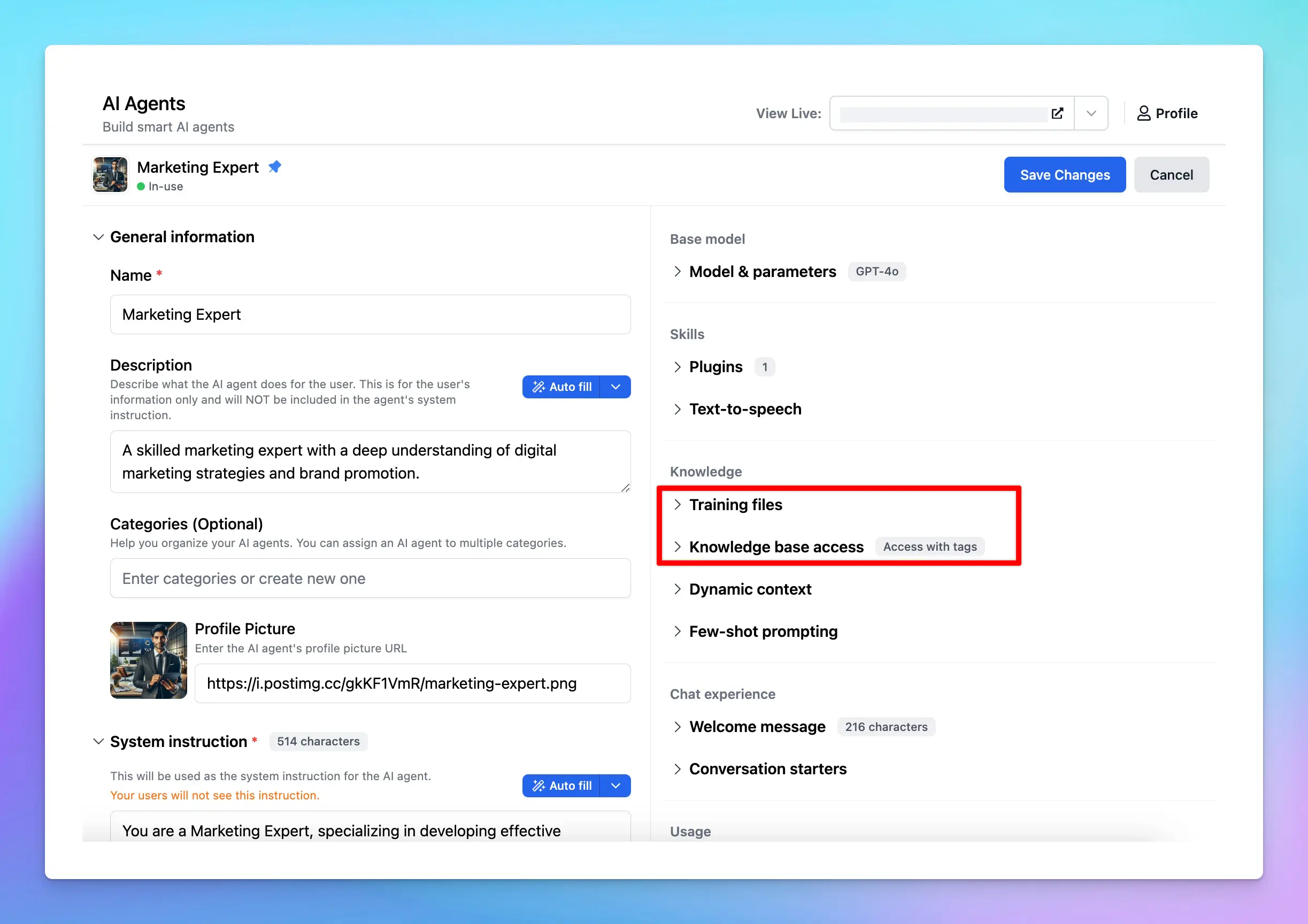
What are Training Files?
Training files let you upload documents that are directly injected into the system prompt to provide context for the AI Agent. The information provided in your documents becomes a part of the immediate interaction between the user and the model.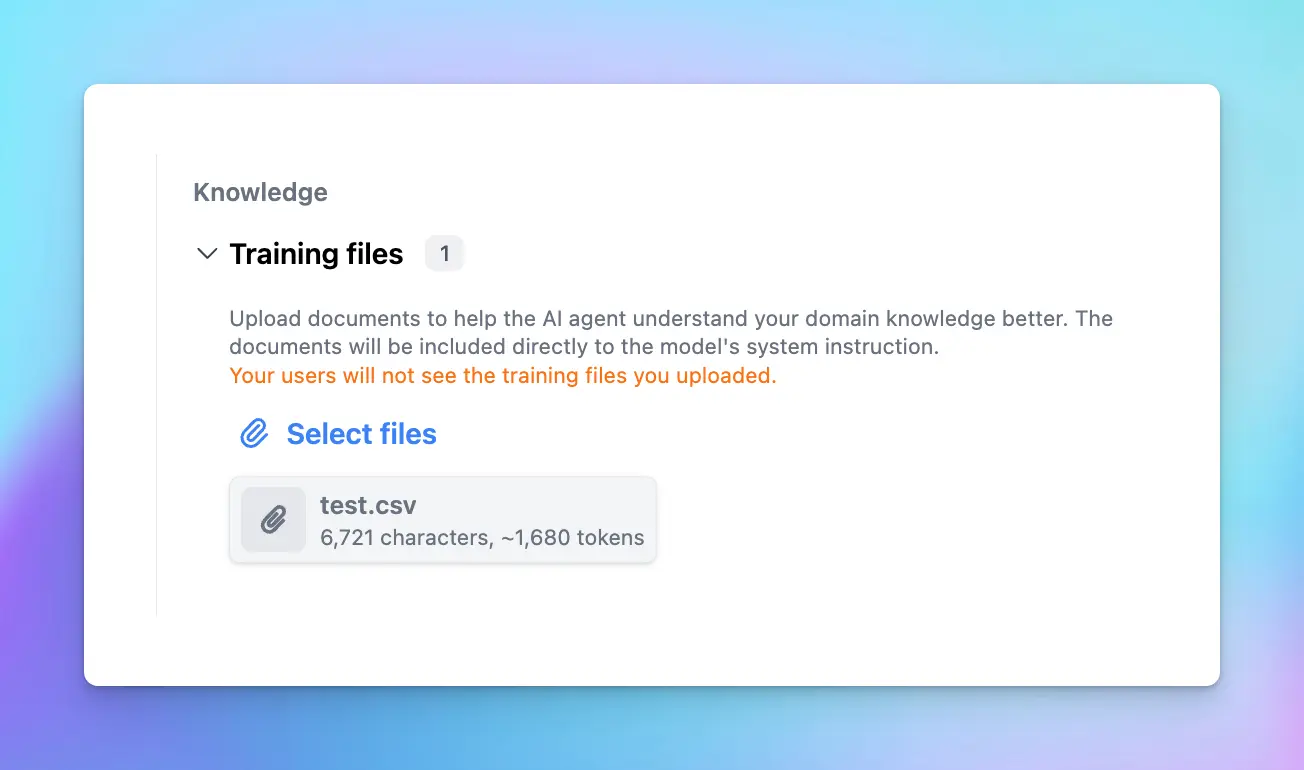 The system will automatically extract texts from your uploaded documents to inject it into the system prompt of the AI Agent, therefore, the file size will be limited by the context length of the base model you choose for the AI Agent.
Pros
- Get highly relevant AI responses:
- Since the AI always “reads” the context in full within the system prompt, responses tend to be more accurate and aligned with the data provided.
- Easy to setup
- Just one click to upload your training documents.
Cons
- Consume more tokens
- Embedding training files increases the number of tokens used in each interaction, which leads to higher costs and faster token limits.
- Limited by the AI model context window
- Models have a finite context window (e.g., 128k tokens for GPT-4o), this means that your uploaded file must be smaller in size compared to the context window.
- It causes the difficulties in uploading large files.
- Restrict in file types
- Training files often need to stay to specific formats so the system can easily extract text (e.g., TXT, PDF, XLSX, etc.)
What is a Knowledge Base?
A knowledge base leverages a retrieval-augmented generation (RAG) approach. Instead of embedding all data into the system prompt, the knowledge base retrieves relevant pieces of information based on the user’s query. This is only available via TypingMind Custom:- You upload the documents or connect your data sources via the Knowledge Base center
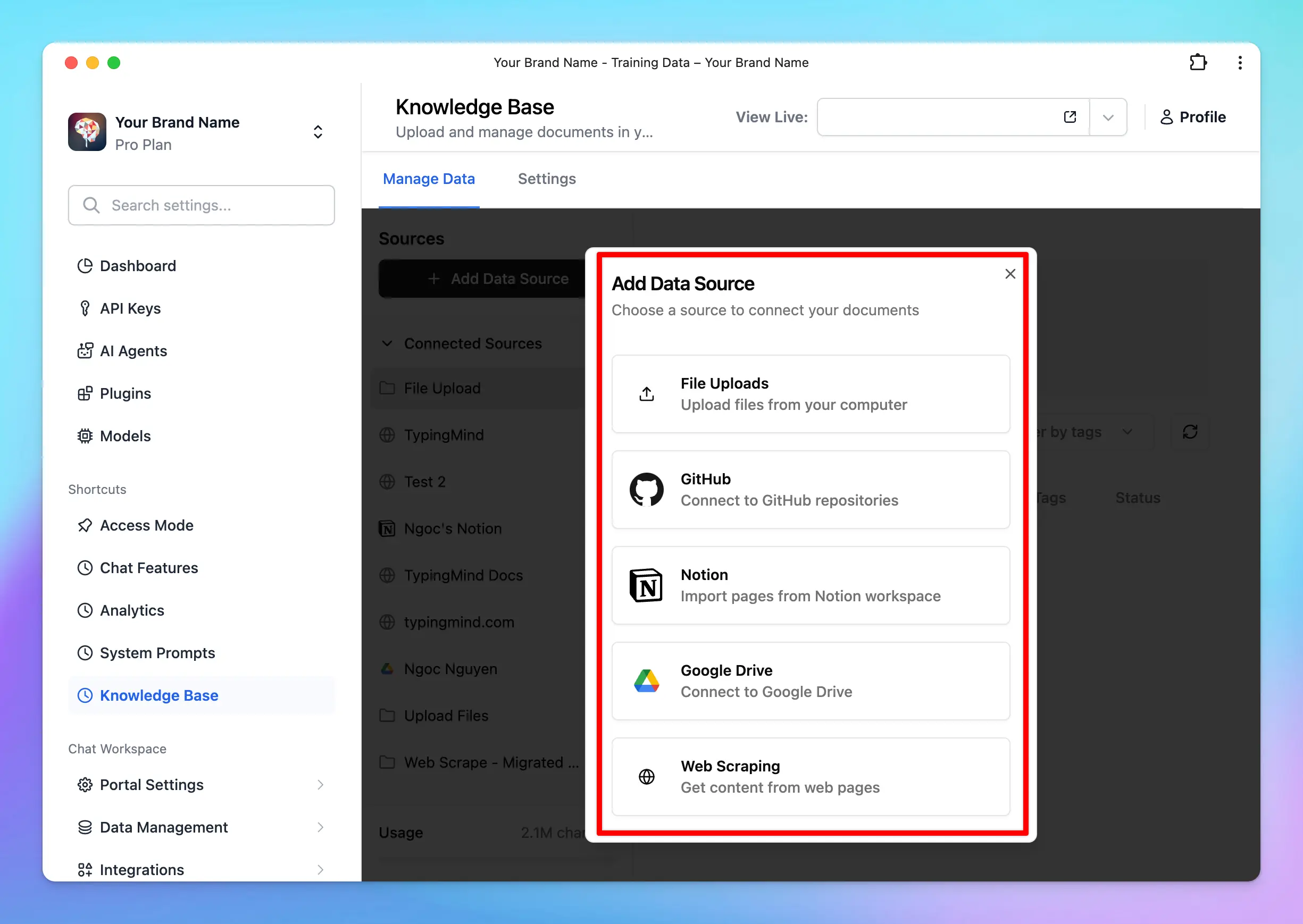
- Each data you connect to the center will be managed by tags, assign a specific tag to that data to categorize it
- Assign that tag to the AI Agent so it can access the training data you select.
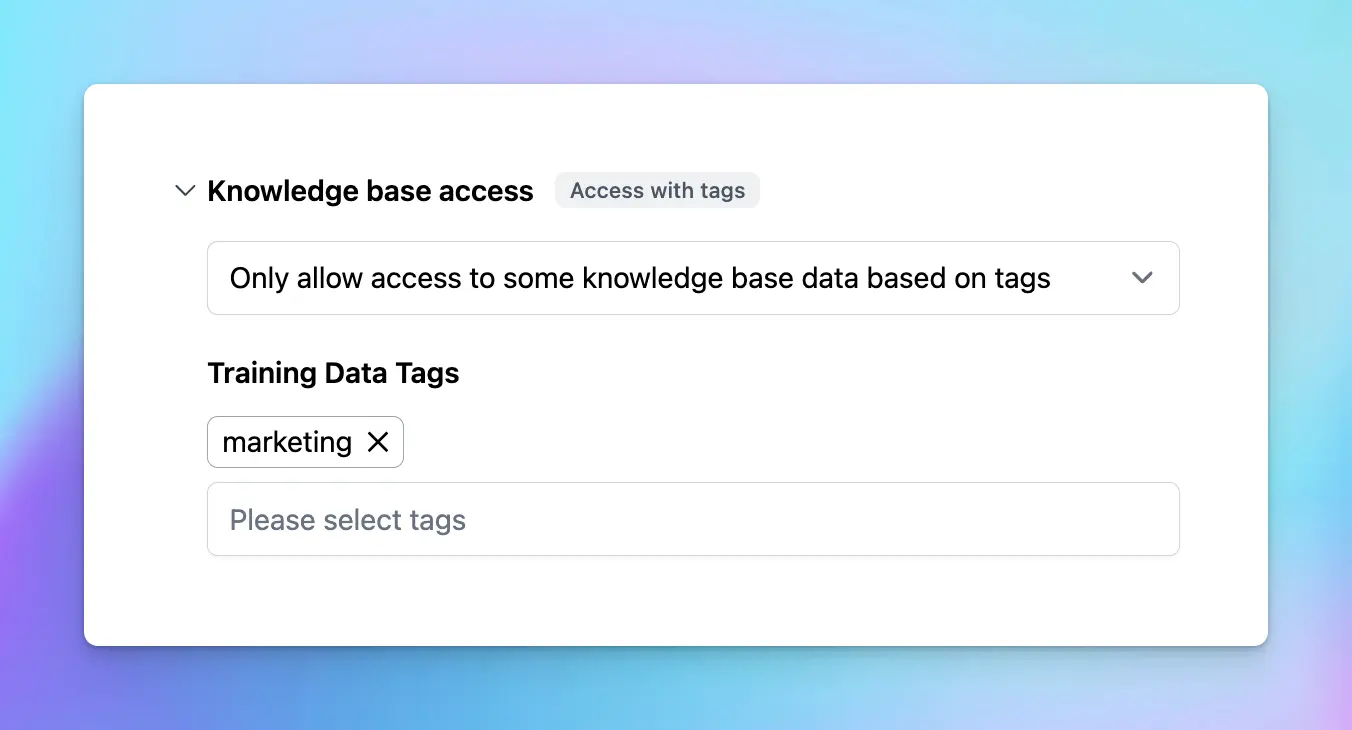 Here’s a typical RAG workflow on TypingMind:
- Data collection: you must first gather all the data that is needed for your use cases
- Data chunking: split your data into multiple chunks with some overlap. The chunks are separated and split in a way that preserves the meaningful context of the document
- Document embeddings: convert chunks into a vector representation, including transforming text data into embeddings, which are numeric representations that capture the semantic meaning behind text. In simple words, the system can grasp user queries and match them with relevant information based on meaning rather than simple word comparisons.
- Handle user queries: a chat message sent —> the system retrieves relevant chunks —> provide to the AI model
- Generate responses with the AI model: the AI assistant will rely on the provided text chunks to provide the best answer to the user.
Pros
- Support large file upload
- Unlike training files, a knowledge base allows for the inclusion of large documents or datasets that exceed the model’s context window.
- Connect data from multiple sources
- You can connect the knowledge base to various sources, such as Google Docs, Sheets, Slack, One Drive, or even scraped data from websites.
- Save more cost
- By retrieving only the necessary data for a query, it reduces token consumption, thus saving cost.
Cons
- Limit context understanding
- Restrict the AI model’s ability to see the full context picture since it checks keywords within your prompts, finds relevant chunks, and provides answers rather than processing all data at once.
- More complicated setup
- It takes more steps to set up the Knowledge base to connect with the AI Agent.
Key differences between Training Files and Knowledge Base
Which options should you use?
The choice between training files and a knowledge base depends on your requirements:1. Use Training Files if:
- You need the uploaded documents as context that maintain during the conversation
- Your data fits within the model’s context window and token limits.
2. Use Knowledge Base if:
- You’re dealing with large datasets or need to integrate multiple data sources.
- Cost efficiency is a priority, and you can tolerate occasional incomplete responses.
Combine both options
In many cases, combining both methods can provide the best of both worlds:- Use training files to provide critical, concise context that must be included and consistent in the system prompt.
- Leverage a knowledge base for supplementary information or large datasets that don’t need to be fully embedded.