> ## Documentation Index
> Fetch the complete documentation index at: https://docs.typingmind.com/llms.txt
> Use this file to discover all available pages before exploring further.
# Memory
> Let TypingMind remember useful context about you across conversations.
Memory allows TypingMind to remember useful information about you across conversations.
Instead of repeating the same context in every new chat, TypingMind can remember things like your preferences, work context, communication style, and other details that may be useful later.
## Memory scopes
TypingMind supports three levels of memory.
Available across all chats, including regular chats, AI Agent chats, and Project chats.
Used only when chatting with a specific AI Agent. Each Agent keeps its own memories.
Used only in chats inside a specific Project. Each Project keeps its own memories.
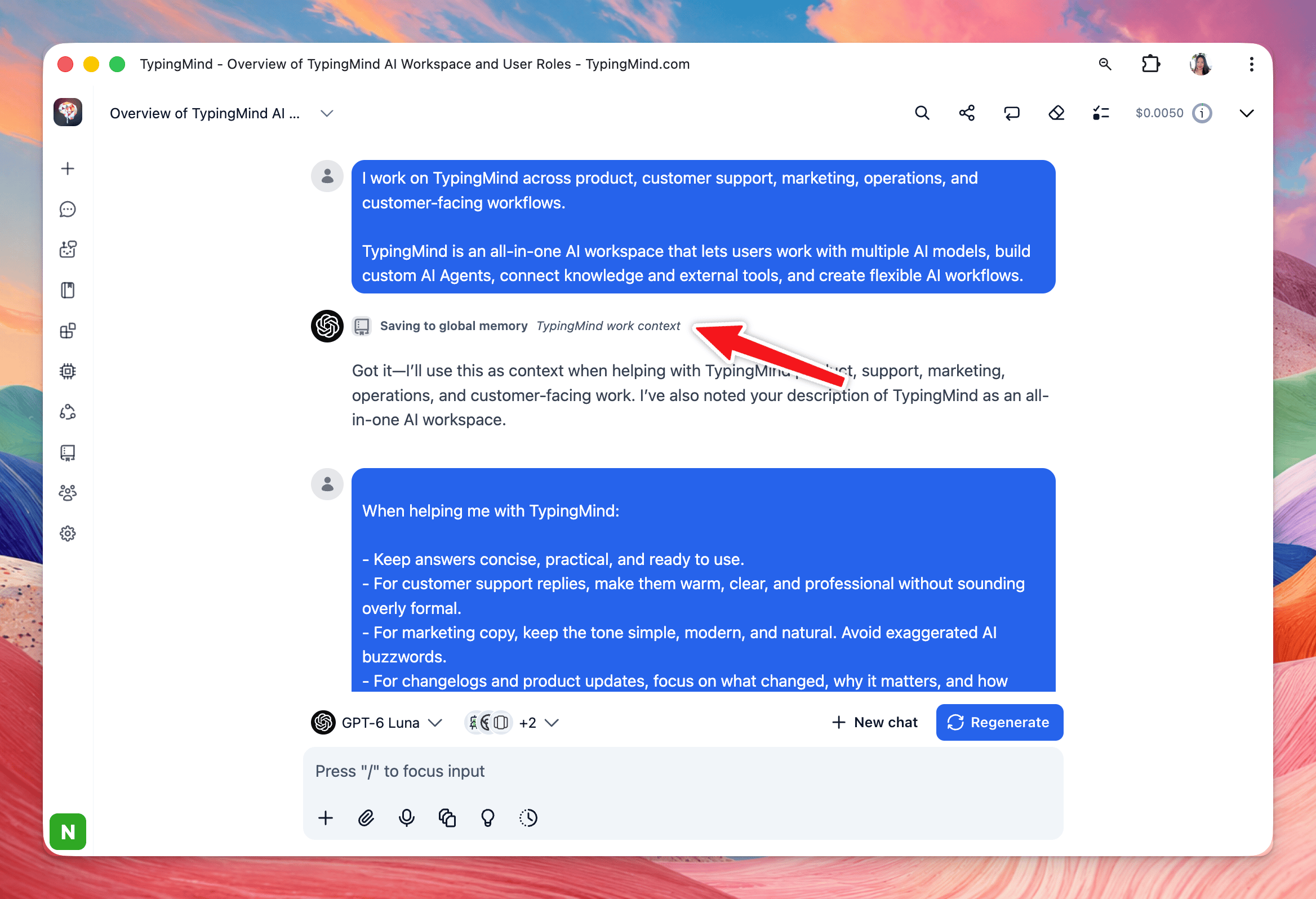
## Global memory
Global memories are available across all chats.
They can be used in:
* Regular chats
* Chats with AI Agents
* Chats inside Projects
Use Global memory for information that is generally useful everywhere, such as:
* Your role
* Writing preferences
* Preferred response style
* Languages you use
* General work context
For example:
> Remember that I prefer short and concise answers.
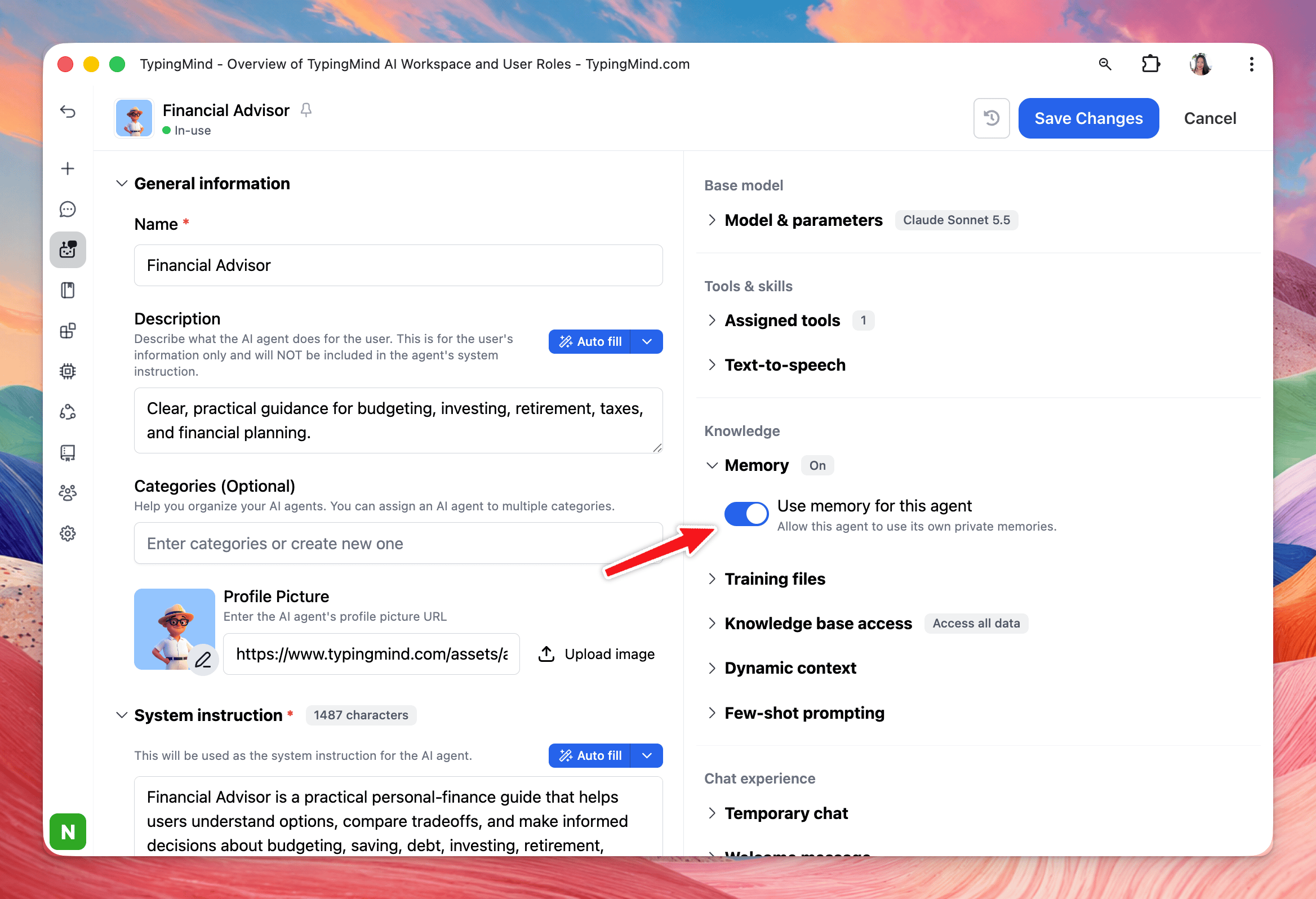
 ## Agent scoped memory
Each AI Agent can keep its own memories.
These memories are only used when you chat with that specific Agent, and they are used alongside your Global memories.
This is useful when different Agents need different context.
For example, your Customer Support Agent could remember:
> I prefer customer replies to be friendly, concise, and professional.
While your Coding Agent could remember:
> Use TypeScript whenever possible.
Each Agent keeps its memories separate from other Agents.
## Agent scoped memory
Each AI Agent can keep its own memories.
These memories are only used when you chat with that specific Agent, and they are used alongside your Global memories.
This is useful when different Agents need different context.
For example, your Customer Support Agent could remember:
> I prefer customer replies to be friendly, concise, and professional.
While your Coding Agent could remember:
> Use TypeScript whenever possible.
Each Agent keeps its memories separate from other Agents.
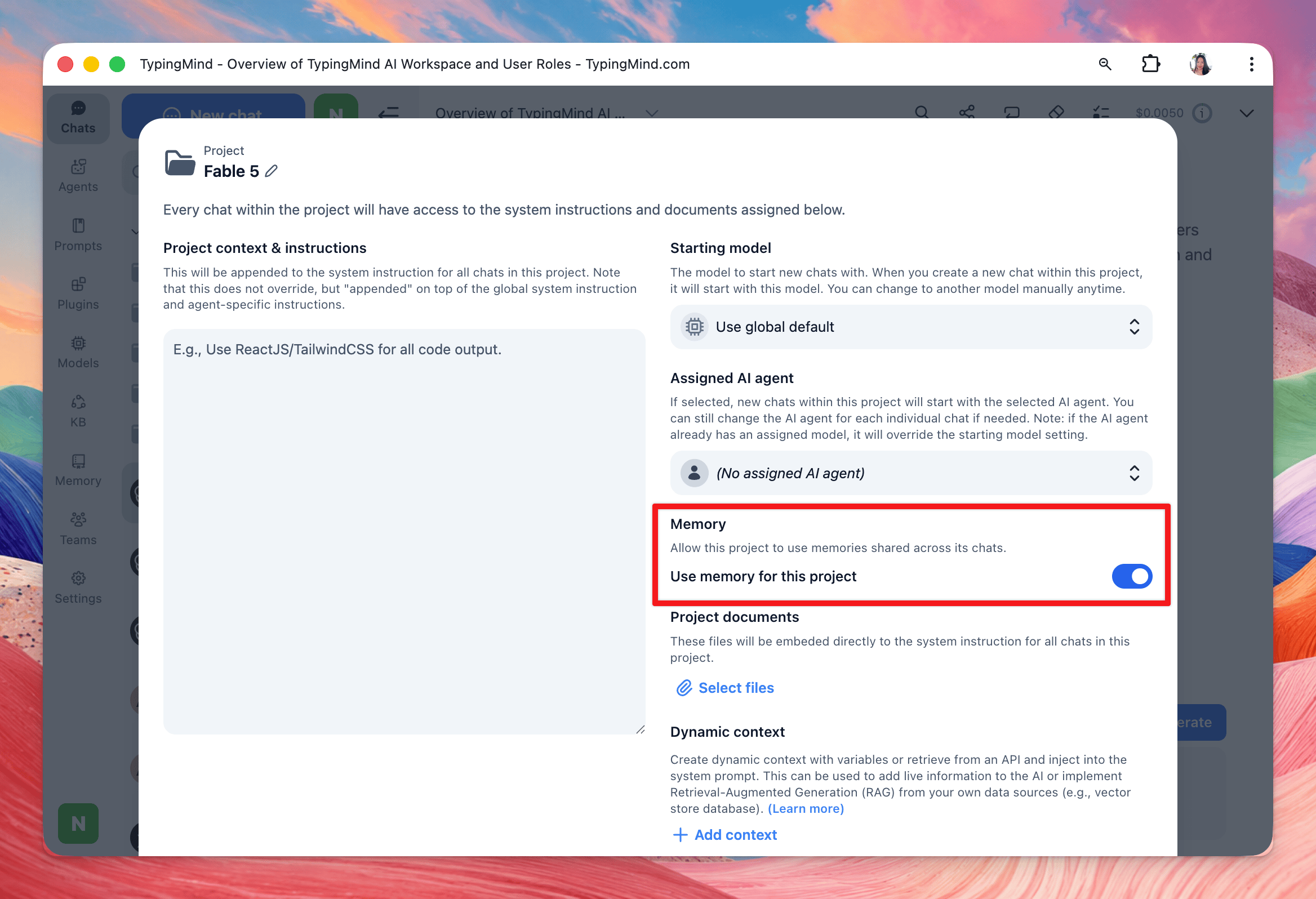
 ## Project scoped memory
Each Project can also keep its own memories.
Project memories are only used in chats inside that Project, and they are used alongside your Global memories.
This is useful for information that belongs to a specific project, such as:
* Project goals
* Product terminology
* Team conventions
* Writing style
* Technical context
For example:
> Remember that this project is for a SaaS product targeting small businesses.
Each Project keeps its memories separate from other Projects.
## Project scoped memory
Each Project can also keep its own memories.
Project memories are only used in chats inside that Project, and they are used alongside your Global memories.
This is useful for information that belongs to a specific project, such as:
* Project goals
* Product terminology
* Team conventions
* Writing style
* Technical context
For example:
> Remember that this project is for a SaaS product targeting small businesses.
Each Project keeps its memories separate from other Projects.
 ## How Memory is combined
The memories available to the AI depend on where you are chatting.
| Chat type | Memory used |
| - | - |
| Regular chat | Global memory |
| Chat with an AI Agent | Global memory + that Agent's memory |
| Chat inside a Project | Global memory + that Project's memory |
Agent and Project memories stay isolated from other Agents and Projects.
## Adding something to Memory
You can ask the AI to remember useful information directly in the chat.
For example:
> Remember that I work in product marketing.
Or:
> Remember that I prefer concise answers with a short summary at the end.
Memory works best for information that will remain useful across future conversations.
## Managing Memory
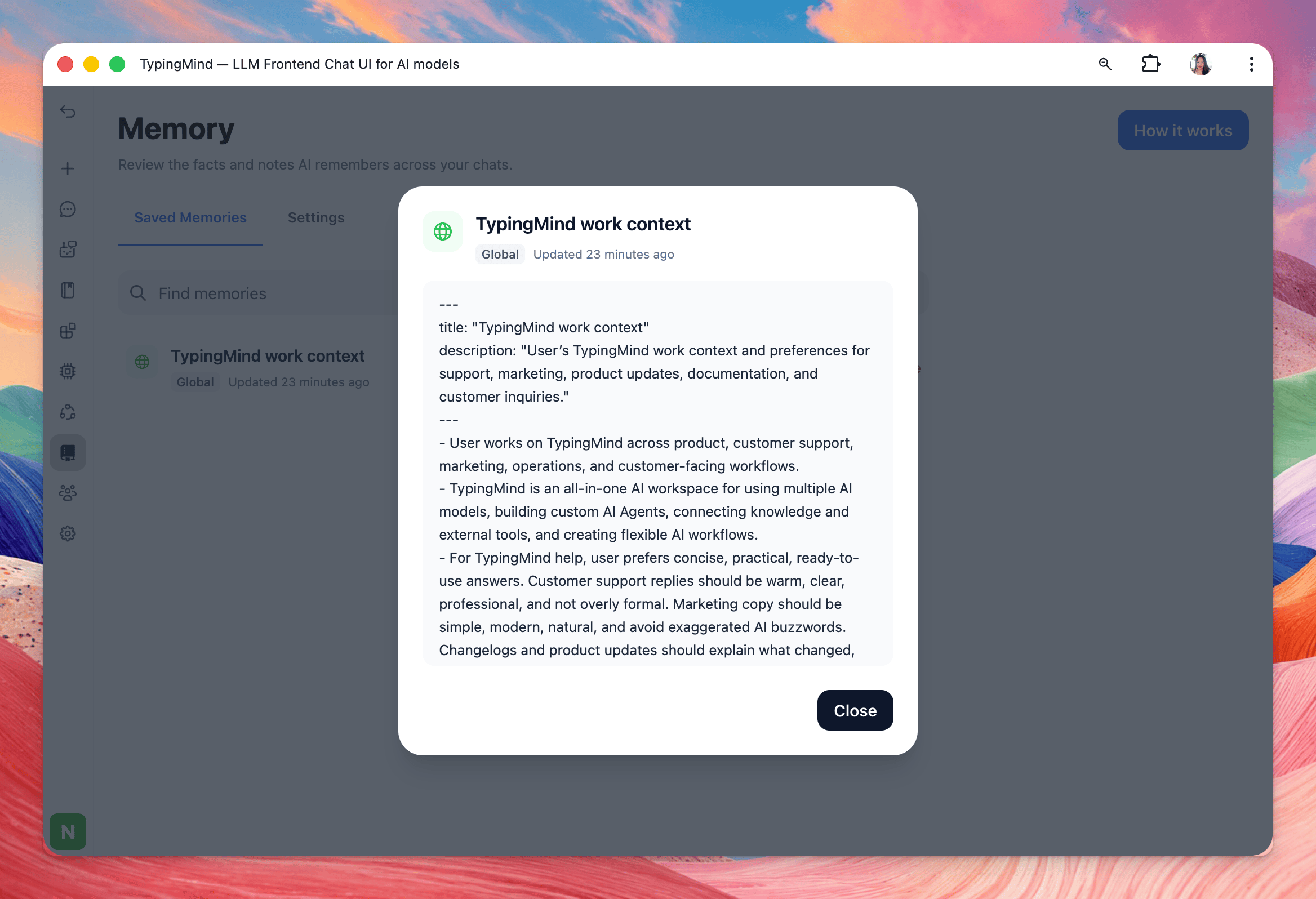
You can review your memories from the **Memory** page.
Go to:
**Memory → Saved Memories**
## How Memory is combined
The memories available to the AI depend on where you are chatting.
| Chat type | Memory used |
| - | - |
| Regular chat | Global memory |
| Chat with an AI Agent | Global memory + that Agent's memory |
| Chat inside a Project | Global memory + that Project's memory |
Agent and Project memories stay isolated from other Agents and Projects.
## Adding something to Memory
You can ask the AI to remember useful information directly in the chat.
For example:
> Remember that I work in product marketing.
Or:
> Remember that I prefer concise answers with a short summary at the end.
Memory works best for information that will remain useful across future conversations.
## Managing Memory
You can review your memories from the **Memory** page.
Go to:
**Memory → Saved Memories**
 You can also open the **Settings** tab to enable or disable:
* Global memory
* Agent scoped memory
* Project scoped memory
Each memory type can be controlled independently.
## What should I save to Memory?
Memory works best for information that stays useful over time.
Good examples include:
* Your role or work context
* Writing preferences
* Communication style
* Project conventions
* Agent-specific context
* Frequently used tools or technologies
Avoid saving temporary information that is only relevant to one conversation.
For example:
> I have a meeting tomorrow at 2 PM.
This is usually better kept in the current chat rather than saved as Memory.
## Memory vs chat history
Chat history contains your previous conversations.
Memory stores useful information that can be reused across future conversations.
This means you can start a new chat without having to repeat important context every time.
This documentation is built and hosted on [Mintlify](https://mintlify.com), a developer documentation platform.
You can also open the **Settings** tab to enable or disable:
* Global memory
* Agent scoped memory
* Project scoped memory
Each memory type can be controlled independently.
## What should I save to Memory?
Memory works best for information that stays useful over time.
Good examples include:
* Your role or work context
* Writing preferences
* Communication style
* Project conventions
* Agent-specific context
* Frequently used tools or technologies
Avoid saving temporary information that is only relevant to one conversation.
For example:
> I have a meeting tomorrow at 2 PM.
This is usually better kept in the current chat rather than saved as Memory.
## Memory vs chat history
Chat history contains your previous conversations.
Memory stores useful information that can be reused across future conversations.
This means you can start a new chat without having to repeat important context every time.
This documentation is built and hosted on [Mintlify](https://mintlify.com), a developer documentation platform.