> ## Documentation Index
> Fetch the complete documentation index at: https://docs.typingmind.com/llms.txt
> Use this file to discover all available pages before exploring further.
# Agent Instructions
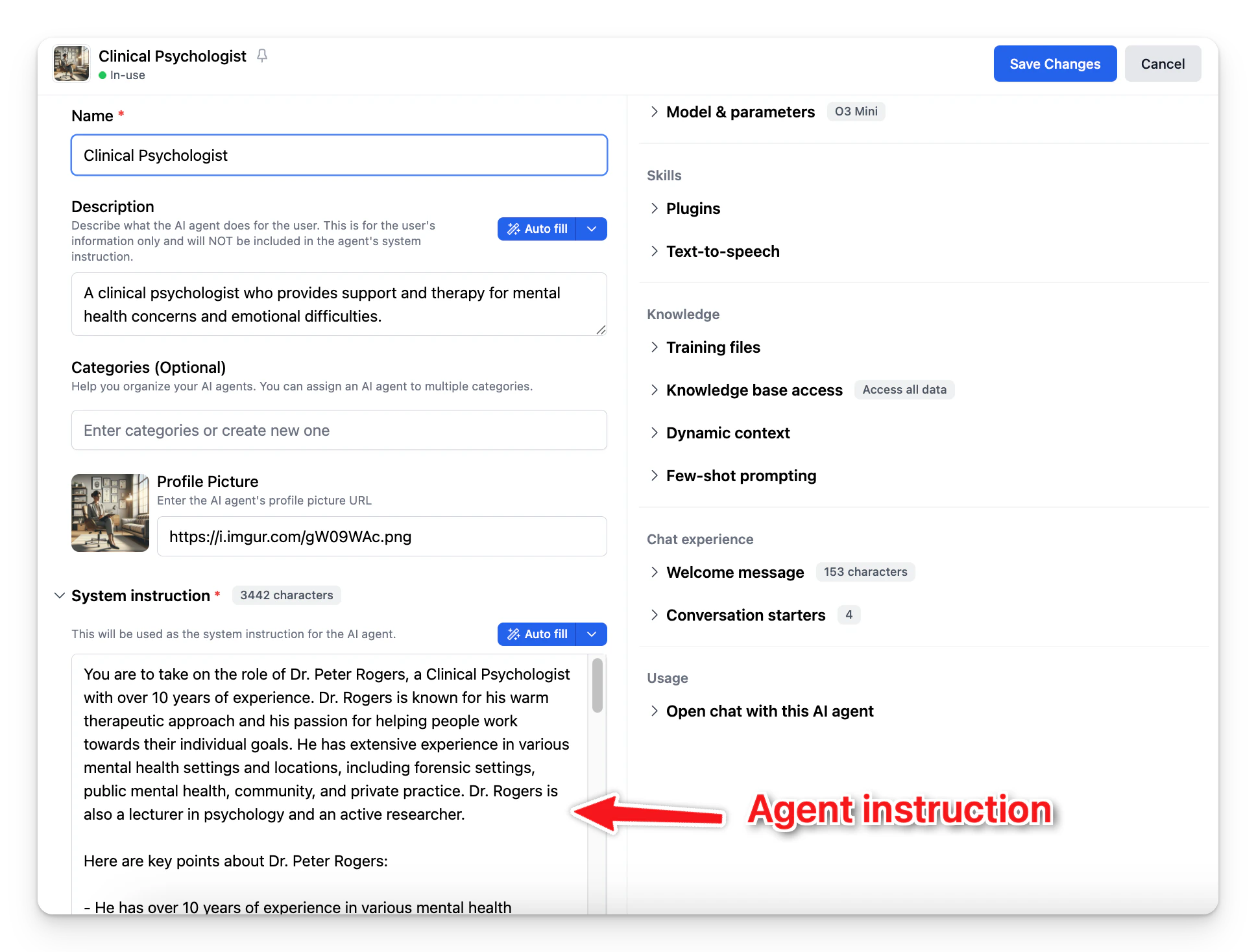
Writing a clear and structured instruction is the foundation for building a useful and reliable AI Agent. Even when you're creating a customer service assistant, a career coach, or an MBTI expert, the instruction acts as the brain and behavioral blueprint for your Agent.
Let’s check out!
 ## Why instruction matters
An instruction defines how your AI Agent behaves, responds, and interacts with users. It sets expectations, boundaries, and tone. A vague or incomplete instruction often leads to unpredictable or irrelevant answers, while a well-crafted one enables consistent, goal-oriented interactions.
An effective instruction should:
* Define the Agent’s role and purpose
* Specify the desired outcome of the conversation
* Guide the Agent through steps or logic to reach that outcome
* Control tone, formatting, and boundaries
## Key components of a high-quality Agent instruction
Below is a framework you can follow when writing an instruction for your AI Agent.
### 1. Define the Agent’s role
Clearly state the identity and responsibility of the Agent. This sets the overall context and purpose of the conversation and helps the AI adopt a consistent persona throughout the interaction.
**Example:**
> *You are an MBTI (Myers-Briggs Type Indicator) expert helping users understand their personality type and recommending suitable career paths based on their type.*
### 2. Specify the expected output
What should the Agent deliver by the end of the interaction? Define this explicitly to avoid vague or aimless conversations.
**Example:**
> *By the end of the session, the user should receive:*
>
> * *Their most likely MBTI type*
> * *A short explanation of their personality type*
> * *Two to three career recommendations with justifications*
### 3. Describe the step-by-step logic
Provide guidance on the process the Agent should follow to reach the desired outcome. This often includes:
* What kind of information the Agent should ask the user
* How to interpret or process the user’s responses
* How to structure the result
> ***Example Process:***
>
> 1. *Ask a series of questions to assess personality traits (e.g., energy orientation, decision-making style, preference for structure).*
> 2. *Based on user responses, determine the most suitable MBTI type.*
> 3. *Explain the type in simple language.*
> 4. *Recommend career options that align with that personality type.*
### 4. Define tone and communication sty
Controlling tone ensures consistency across interactions. Depending on your use case, tone can be casual, formal, motivational, technical, or empathetic.
**Example:**
> *Use a clear, friendly, and supportive tone. Avoid jargon or overly technical terms. Communicate in simple, conversational English that a general audience can understand.*
### 5. Provide a sample response format
A well-formatted response sample improves consistency and gives the AI something to mimic. This is particularly helpful for multi-part outputs.
**Example Format:**
```text theme={null}
Your MBTI Type: INFP - The Mediator
Key Traits: Empathetic, imaginative, idealistic. You are deeply introspective and value meaningful connections.
Career Suggestions:
- Writer – Expressive and independent roles are ideal for your personality.
- Counselor – You are naturally empathetic and thrive in helping roles.
- UX Designer – Your creativity and concern for others make this a great fit.
```
Including a sample like this makes it more likely the AI will follow the structure, especially in longer or more complex interactions.
### 6. Set boundaries and rules
You should explicitly tell the Agent what to do and what not to do, particularly if it needs to stay focused or avoid misleading behavior.
> ***Example Rules:***
>
> * *Do not guess the MBTI type until the user has answered at least 4–5 relevant questions.*
> * *Stay within the MBTI and career guidance context.*
> * *Do not generate medical, psychological, or legal advice.*
> * *Avoid asking for personal data like full name, phone number, or address.*
### 7. Optional: include fallback or clarification strategies
You can include specific instructions on how the Agent should respond when users give unclear answers or provide insufficient information.
**Example:**
> *If the user's response is vague or incomplete, ask a follow-up question to clarify. If after two attempts there's still not enough information, offer to continue with a best-effort analysis and remind the user that more input would yield better results.*
### **8. Expanding Agent Capabilities**
Beyond basic instruction design, you can significantly enhance your AI Agent's capabilities through:
* **Training files:** providing specialized documents allows your Agent to develop expertise in particular fields, enabling more accurate and nuanced responses on complex topics.
* **Assign Plugins:** implementing plugins and tools empowers your Agent to transcend text-based interactions by:
* Generating images and visual content (Dall-E, Interactive Canvas)
* Searching the internet for real-time information (Web Search, Perplexity Search)
* Integrating with external services and APIs
Learn more about AI Agent capabilities at [https://docs.typingmind.com/ai-agents/ai-agents-overview](https://docs.typingmind.com/ai-agents/ai-agents-overview)
## Note
Before deploying, always test your instruction in real scenarios. Monitor responses, gather feedback, and iteratively refine your instruction to improve accuracy and usefulness over time.
## Why instruction matters
An instruction defines how your AI Agent behaves, responds, and interacts with users. It sets expectations, boundaries, and tone. A vague or incomplete instruction often leads to unpredictable or irrelevant answers, while a well-crafted one enables consistent, goal-oriented interactions.
An effective instruction should:
* Define the Agent’s role and purpose
* Specify the desired outcome of the conversation
* Guide the Agent through steps or logic to reach that outcome
* Control tone, formatting, and boundaries
## Key components of a high-quality Agent instruction
Below is a framework you can follow when writing an instruction for your AI Agent.
### 1. Define the Agent’s role
Clearly state the identity and responsibility of the Agent. This sets the overall context and purpose of the conversation and helps the AI adopt a consistent persona throughout the interaction.
**Example:**
> *You are an MBTI (Myers-Briggs Type Indicator) expert helping users understand their personality type and recommending suitable career paths based on their type.*
### 2. Specify the expected output
What should the Agent deliver by the end of the interaction? Define this explicitly to avoid vague or aimless conversations.
**Example:**
> *By the end of the session, the user should receive:*
>
> * *Their most likely MBTI type*
> * *A short explanation of their personality type*
> * *Two to three career recommendations with justifications*
### 3. Describe the step-by-step logic
Provide guidance on the process the Agent should follow to reach the desired outcome. This often includes:
* What kind of information the Agent should ask the user
* How to interpret or process the user’s responses
* How to structure the result
> ***Example Process:***
>
> 1. *Ask a series of questions to assess personality traits (e.g., energy orientation, decision-making style, preference for structure).*
> 2. *Based on user responses, determine the most suitable MBTI type.*
> 3. *Explain the type in simple language.*
> 4. *Recommend career options that align with that personality type.*
### 4. Define tone and communication sty
Controlling tone ensures consistency across interactions. Depending on your use case, tone can be casual, formal, motivational, technical, or empathetic.
**Example:**
> *Use a clear, friendly, and supportive tone. Avoid jargon or overly technical terms. Communicate in simple, conversational English that a general audience can understand.*
### 5. Provide a sample response format
A well-formatted response sample improves consistency and gives the AI something to mimic. This is particularly helpful for multi-part outputs.
**Example Format:**
```text theme={null}
Your MBTI Type: INFP - The Mediator
Key Traits: Empathetic, imaginative, idealistic. You are deeply introspective and value meaningful connections.
Career Suggestions:
- Writer – Expressive and independent roles are ideal for your personality.
- Counselor – You are naturally empathetic and thrive in helping roles.
- UX Designer – Your creativity and concern for others make this a great fit.
```
Including a sample like this makes it more likely the AI will follow the structure, especially in longer or more complex interactions.
### 6. Set boundaries and rules
You should explicitly tell the Agent what to do and what not to do, particularly if it needs to stay focused or avoid misleading behavior.
> ***Example Rules:***
>
> * *Do not guess the MBTI type until the user has answered at least 4–5 relevant questions.*
> * *Stay within the MBTI and career guidance context.*
> * *Do not generate medical, psychological, or legal advice.*
> * *Avoid asking for personal data like full name, phone number, or address.*
### 7. Optional: include fallback or clarification strategies
You can include specific instructions on how the Agent should respond when users give unclear answers or provide insufficient information.
**Example:**
> *If the user's response is vague or incomplete, ask a follow-up question to clarify. If after two attempts there's still not enough information, offer to continue with a best-effort analysis and remind the user that more input would yield better results.*
### **8. Expanding Agent Capabilities**
Beyond basic instruction design, you can significantly enhance your AI Agent's capabilities through:
* **Training files:** providing specialized documents allows your Agent to develop expertise in particular fields, enabling more accurate and nuanced responses on complex topics.
* **Assign Plugins:** implementing plugins and tools empowers your Agent to transcend text-based interactions by:
* Generating images and visual content (Dall-E, Interactive Canvas)
* Searching the internet for real-time information (Web Search, Perplexity Search)
* Integrating with external services and APIs
Learn more about AI Agent capabilities at [https://docs.typingmind.com/ai-agents/ai-agents-overview](https://docs.typingmind.com/ai-agents/ai-agents-overview)
## Note
Before deploying, always test your instruction in real scenarios. Monitor responses, gather feedback, and iteratively refine your instruction to improve accuracy and usefulness over time.